Snagging Inspection: What It Is and What to Check (UK)
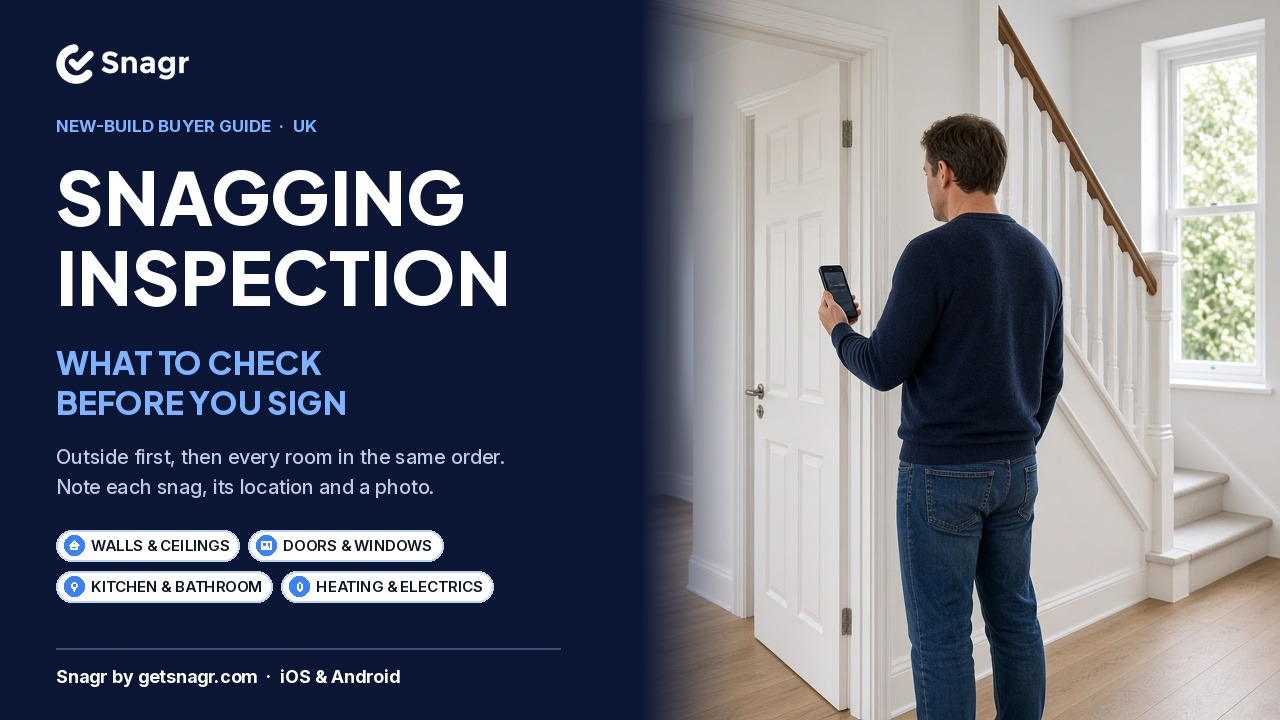
A snagging inspection is a careful, room-by-room check of a new-build home to find defects, damage and unfinished work, so the developer can put them right. It normally happens just before legal completion or soon after you move in, and it ends with a written snag list: each issue, where it is, and a photo.
This guide covers what a snagging inspection is, when to book it, what to check and how to record each snag. For walk-round technique, see our separate guide: 10 tips for a more thorough snagging inspection. If you are new to the term, start with what snagging means for homebuyers.
What is a snagging inspection?
A snagging inspection (also called a snagging survey or new-build inspection) is a structured look at a newly built home and its plot, to confirm that finishes, fixtures, fittings and visible building elements meet the expected standard, and to list anything that does not.
The Residential Property Surveyors Association (RPSA) describes a snag as "any defect, fault, or unfinished element in a newly built home", from a door that will not close or cracked tiles to a window that does not seal correctly. It also notes that most new homes will have snags, which is why a methodical check matters.
Snag or defect?
The two words are often used interchangeably, but the industry does draw a line. The RPSA's New-Build Inspection and Reporting Standards quote the definitions adopted by the New Homes Quality Board (NHQB):
- Snag: "A minor imperfection or malfunction in the Complete New Home that does not meet recognised industry standards, finishings and tolerances." Typically something damaged, broken, not fitted properly or unfinished.
- Defect: "Failure to meet the New Home Warranty provider's specified technical standard."
A snagging inspection is mainly about the first group. If something looks more serious, such as damp or a safety concern, record it and take professional advice.
When should you do a snagging inspection?
You can snag at two points, and many buyers do both.
1. Before legal completion (pre-completion inspection). This is the ideal time, because issues can be raised before you take ownership and you get a dated record that they were already there. Under the New Homes Quality Code, developers registered with the NHQB must give you the chance to inspect before completion. The Code says this should happen after the notice to complete has been served and before the completion date (or earlier if you and the developer both agree).
2. After you move in. Some snags only appear once you live in a home, such as a radiator that will not heat or sealant that splits. The RPSA notes that a snagging survey is still valuable after completion, because developers are expected to deal with defects reported within their after-sales service period. How long that period lasts, and what it covers, depends on your developer and warranty documents, so check your own paperwork instead of relying on a general figure.
Practical timing tips:
- Book early: once you have a completion date, ask the developer how to arrange access.
- Go in daylight. The NHQB checklist guidance says internal walls, ceilings and paintwork should be viewed in daylight from at least 2 metres, without shining a light on the surface.
- Follow site safety rules. The Code allows developers to refuse access to anyone who ignores the health and safety precautions they set for a site that is still under construction.
What is a pre-completion inspection (PCI)?
A pre-completion inspection (PCI) is the formal snagging inspection set out in the New Homes Quality Code. If your developer is registered with the NHQB, the Code requires them to give you the opportunity to carry out a PCI yourself, or to appoint a suitably qualified inspector to do it, before completion.
Key points from Part 2 of the Code (section 2.8):
- The inspection must be carried out and recorded using the NHQB Pre-Completion Inspection Checklist.
- The checklist can be used in electronic or digital form, but the checks on the original template must still be carried out.
- If issues breach the warranty technical standards, the developer is responsible for addressing them, "ideally before legal completion or within 30 days if this is not possible".
- The PCI is not meant to delay completion; the developer must respond to the results under Part 3 of the Code.
The NHQB Pre-Completion Inspection Checklist (House, Version 2, March 2026) describes the inspection as "non-disruptive and non-invasive". It also says each report should include a description of the property, where each room is, any limitations (such as weather), and "photographs and explanatory notes of all matters identified".
You can check whether your developer is registered on the NHQB's public Register of Developers. The current Code applies to homes reserved from 2 March 2026; if you reserved earlier, check which version applies.
What should you check in a new-build snagging inspection?
Work in a fixed order so nothing gets skipped. A common method, used by guides such as Property Passport UK, is to start outside and then follow the same sequence in every room: ceiling, walls, floor, windows, doors, electrics, heating and finishes.
The headings below follow the main sections of the NHQB checklist. They are an overview, not a full checklist. For detailed walk-round technique, see our snagging inspection tips.
Outside the home
- Brickwork, render and cladding: consistent colour and texture, no obvious chips, cracks or mortar smears. The NHQB guidance says external walls should be viewed in daylight from at least 10 metres.
- Roof, gutters and downpipes: tiles laid evenly, gutters fixed securely, nothing missing.
- Windows and doors: frames sealed, undamaged and opening properly. Check that keys are present.
- Paths, drive and garden: no trip hazards, no leftover building materials, sensible falls away from the house. Fences and gates should be secure.
Inside, room by room
- Walls and ceilings: plaster joints not visible, no popped screws, paint applied evenly with no splashes on switches or sockets.
- Floors: flat and free from excessive creaks, tiles and boards square to the walls, carpets neatly fitted with threshold bars where needed.
- Doors and joinery: doors open and close without catching, handles and locks work, skirting is fitted neatly, stairs are solid and the handrail is secure.
- Windows and glazing: handles and restrictors work, glass is free from obtrusive scratches or bubbles, seals run all the way round.
- Kitchen and fitted furniture: units level, door gaps consistent, worktop joints tight, appliances installed as specified and working.
- Bathrooms: tiles and grout even, sealant unbroken, taps hot and cold, WCs flush and are fixed firmly, no leaks under basins or baths.
- Services: lights and sockets work and are fitted level, heating and radiators work without leaks, extractor fans run, and the consumer unit is labelled.
- Loft (only if safely accessible): insulation evenly laid, hatch secure, no debris left behind.
Also check the handover paperwork. The Code lists items the developer must provide at completion, including a Schedule of Incomplete Work and details of guarantees and warranties.
Should you hire a snagging surveyor or do it yourself?
Doing it yourself: you can take your time, but you may miss things a trained eye would catch. The NHQB checklist itself warns that someone who is not qualified to survey residential property "may overlook or misinterpret certain requirements". If you go it alone for a PCI, use the official NHQB checklist.
Hiring a professional: the RPSA argues that trained surveyors understand construction methods, warranty standards and accepted tolerances, and that a professional report "carries far more weight with a developer than a personal list of complaints". For a PCI under the Code, a third-party inspector must be "suitably qualified". The Code says this means membership of a recognised professional association (it gives examples such as CABE, CIOB, ICWCI, RICS and RPSA), relevant professional indemnity insurance, working within their competency and using the standard checklist. Ask any inspector to confirm these points before you book.
Some buyers combine the two: a professional inspection before completion, then their own list of anything that appears later.
How do you record and submit snags?
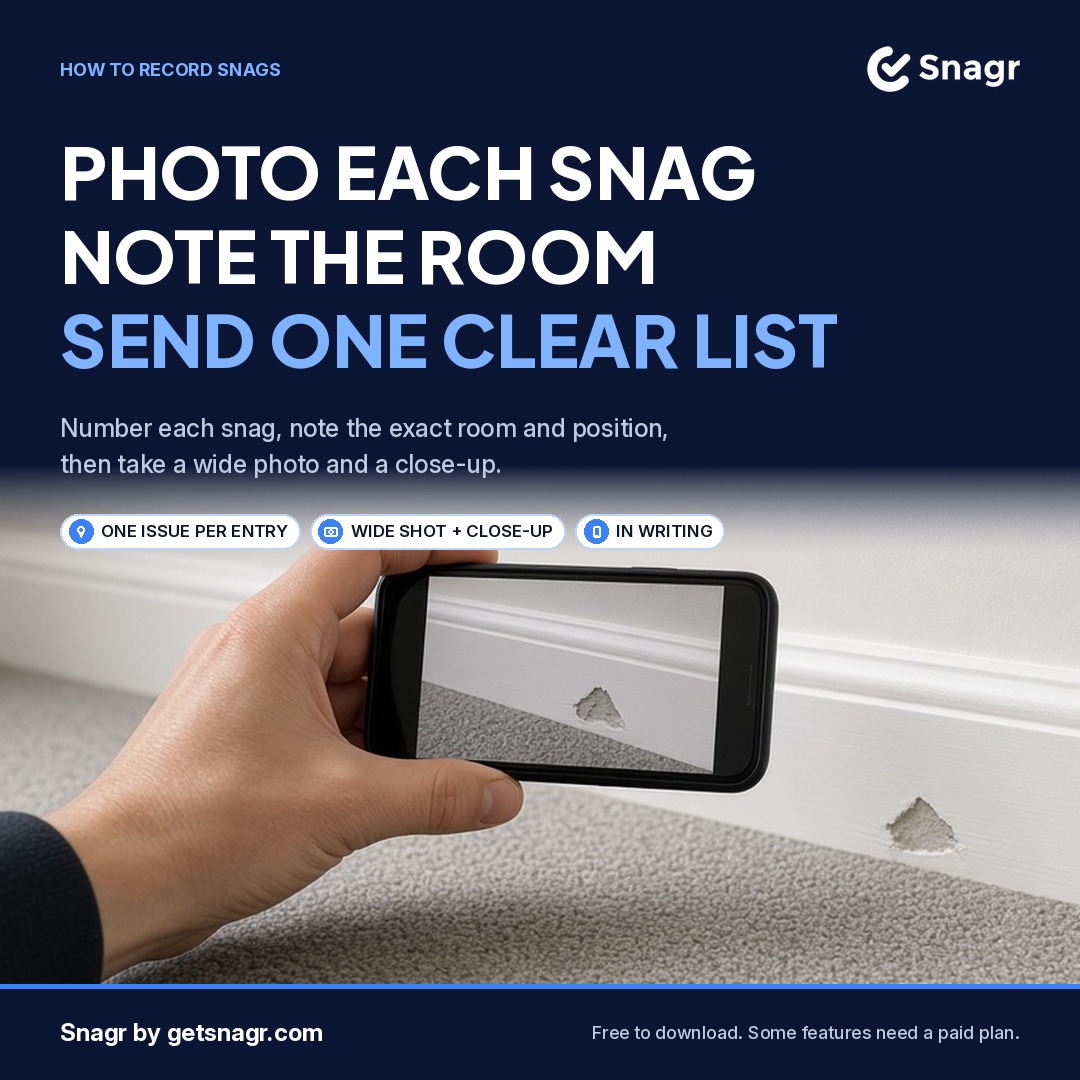
A snag list only works if the developer can find, fix and check each item without phoning you to ask what you meant. For every issue:
- Give it a number, so you can match it against the developer's reply.
- Name the location exactly: room, wall and position (for example "Bedroom 2, window wall, left of the radiator").
- Describe what is wrong in plain words and what "fixed" should look like.
- Take photos: one wide shot to show where it is and one close-up to show the problem. The RPSA reporting standards suggest at least one image of each snag. Video helps for noises, leaks or doors that catch.
- Note the date of the inspection and any limitations, such as poor weather or rooms you could not reach.
- Submit it in writing through the developer's customer care or after-sales process, and keep a copy. Email gives you a timestamp and a paper trail.
- Re-check each repair before you treat the item as closed.
Recording your inspection with Snagr
To keep notes and photos together in one list, you can use a snagging app. With Snagr by getsnagr.com you can:
- Record each issue with a note or photo and its location
- Create a snag with a photo or video
- Annotate images to point out the exact problem
- Update each snag's status yourself as repairs are done
- Export reports as PDF and Excel
- Share reports by link or email
Snagr is available on iPhone and iPad from the App Store and on Android from Google Play. Free to download. Some features need a paid plan. See the new-build snagging app page, or download Snagr.
For a formal PCI, the NHQB checklist must still be followed. A digital tool can help you record and share findings, but it does not replace the checks on the official template.
Snagging inspection vs home survey
A snagging inspection and a home survey answer different questions. As SDL Surveying explains, a snagging report is mainly used for new-build homes and focuses on finishes, fixtures, fittings and incomplete work. A home survey, such as a Level 2 or Level 3 survey, is usually bought for an existing home and looks at its overall condition, including issues like damp, subsidence and the roof.
FAQ
What is a snagging inspection?
A snagging inspection is a methodical check of a new-build home and its plot to find defects, damage and unfinished work. It produces a written list of each issue, its location and photos, which the developer uses to put things right.
When should you do a snagging inspection?
Ideally before legal completion, as a pre-completion inspection, so issues are recorded before you take ownership. You can also snag after you move in, as some issues only show once the home is lived in. Check your developer and warranty documents for how long you have to report issues.
What is a pre-completion inspection (PCI)?
A PCI is the formal snagging inspection set out in the New Homes Quality Code. Developers registered with the NHQB must give buyers the chance to inspect before completion, either themselves or through a suitably qualified inspector, using the NHQB Pre-Completion Inspection Checklist.
What should you check in a new-build snagging inspection?
Check outside first (brickwork, roof, gutters, windows, doors, paths and garden), then every room in the same order: ceilings, walls, floors, windows, doors, electrics, heating, kitchen and bathroom fittings, and the loft if it is safely accessible.
Should you hire a snagging surveyor or do it yourself?
You can do either. A professional brings training and a report developers tend to take seriously; doing it yourself makes it easier to miss things. For a PCI under the Code, a third-party inspector must be suitably qualified, for example a member of a recognised professional body with professional indemnity insurance.
How do you record and submit snags?
Number each snag, note the exact room and position, describe the problem, and take a wide photo and a close-up. Then submit one clear list in writing through the developer's customer care process and keep a copy.
What is the difference between a snagging inspection and a home survey?
A snagging inspection is for new-build homes and focuses on finishes, fittings and incomplete work. A home survey, such as a Level 2 or Level 3 survey, is usually for existing homes and assesses wider condition issues such as damp, subsidence and the roof.
Sources
- New Homes Quality Code, Part 2: Legal documents, information, inspection & completion (NHQB)
- NHQB Pre-Completion Inspection Checklist: House, Version 2 (March 2026)
- Snagging surveys (RPSA)
- RPSA New-Build Inspection and Reporting Standards, v1.4 (Nov 2021)
- How to write a snagging list room by room (Property Passport UK)
- What is a snagging report? (SDL Surveying)
This article is general information, not legal or surveying advice. Your rights depend on your contract, your developer and your warranty documents.
Record your snagging inspection with Snagr.
Note or photograph each issue with its location, then export a PDF or Excel report to share by link or email.
Free to download. Some features need a paid plan. · getsnagr.com